Archived frontend learning · Sass and build workflow
SassBoilerplate
Learning how a small Sass codebase connects to a build workflow.
- Contribution
- Frontend learning and starter-workflow adaptation
- Evidence
- Public source artifact
The project and my part in it
SassBoilerplate is an earlier learning archive based on JR Cologne’s Gulp Starter Kit. My contribution was learning and adaptation around that starter, with its original author and MIT license retained.
The source offers a simple way to explain what I was working through: where styles begin, how imports connect and what the build tasks do with them.
What shaped the design
- The original starter-kit authorship and MIT attribution must remain clear.
- The archive has a small actual import structure.
- Historical dependencies need review before use with a current runtime.
THE DESIGN CHALLENGE
What did a small starter workflow teach me about making frontend structure understandable?
The walkthrough follows the files from the Sass entry point to the generated output. It stays with the structure that is actually present in the archive.
Start at the stylesheet entry point
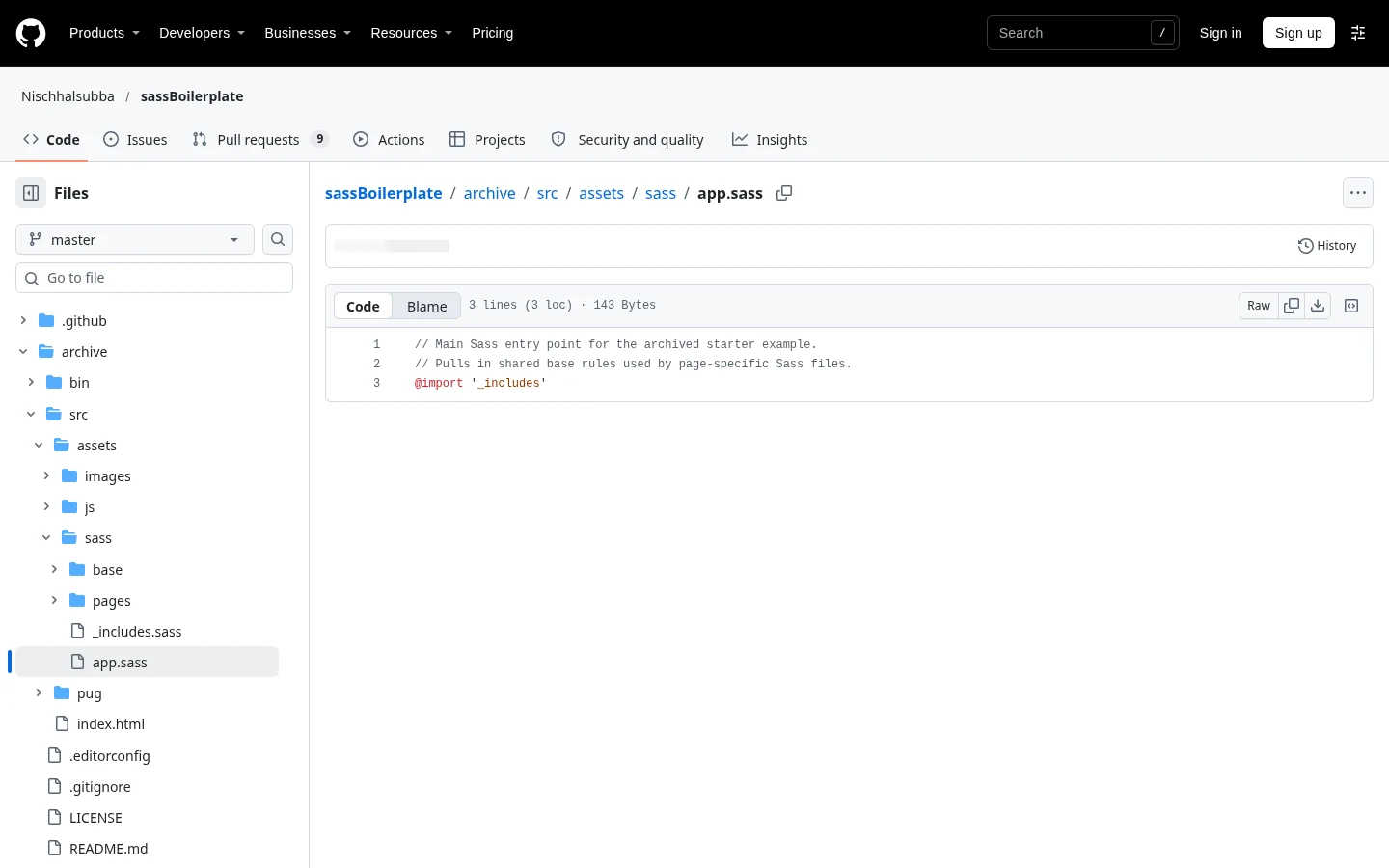
The archived app.sass imports _includes, which imports base/_base. That gives the styles a short dependency path that is easy to inspect.
Source comments explain that empty helper, module, partial and global placeholders were removed. The remaining structure is small, so there is no need to describe a larger component or token architecture that is not there.
// app.sass
@import '_includes'

// _includes.sass
@import 'base/_base'Folders are useful when they have a responsibility, not simply because a starter can include them.
Understand what each build task owns
The Sass task reads Sass and SCSS, handles compilation and errors, adds prefixes, minifies the result and writes source maps. Other tasks handle templates, JavaScript, images and copied dependencies.
Reading those responsibilities helped connect source organization with the output. It also shows why a modern migration has to check the historical toolchain as well as the stylesheet files.
Separate tasks make the workflow easier to follow, while older dependencies can still limit whether it runs today.
Keep the learning archive in context
The README credits JR Cologne and the upstream kit, with the MIT license. It also records historical tooling requirements that need review before any current use.
I include the archive to explain the learning and adaptation. It is not a new framework or a maintained package release.
An archive can explain how the work developed without presenting old tooling as a current recommendation.
Public source artifact
What I delivered
A public learning archive with inspectable Sass imports, named build tasks and upstream attribution.
Outcomes and next steps
The source explains the relationship between stylesheet organization and build responsibilities. The historical dependencies were not installed or executed for this case.
What I would test next
- Ask a developer unfamiliar with the archive to locate the source styles, build entry point and generated output.
- Review upstream attribution and dependency age before deciding what can be learned from the structure or reused in a maintained project.
What I learned
A small working dependency path is easier to maintain than a large folder structure with no clear responsibilities.