Product design / Practical notes
When a Startup Needs a UX Audit Before a Redesign
An audit is useful when the team cannot yet explain why a task is failing. When the defect is already clear, start with the repair.
Identify the decision you cannot yet make
Before proposing a redesign, name the decision the team cannot make. Are people missing a step, misunderstanding the product or running into a service problem?
If several explanations fit, a small task-based audit can help choose a direction. If a broken link or missing label is already confirmed, the team can fix it without waiting for a large study.
Choose a response that matches the evidence
| Situation | Useful next move |
|---|---|
| A known broken save | Repair and regression-test the failure |
| Conflicting explanations for abandonment | Collect evidence around the affected task |
| A new role or business model | Review the task and information architecture |
| Inconsistent UI with stable behavior | Assess component and content-system repair |
| A new visual direction only | Bound the visual work and protect existing behavior |
Scope the audit around a consequential journey
For a small team, start with one important role and one end-to-end task. Include entry, input, waiting, failure and completion. Identify the integrations and account states needed to test it.
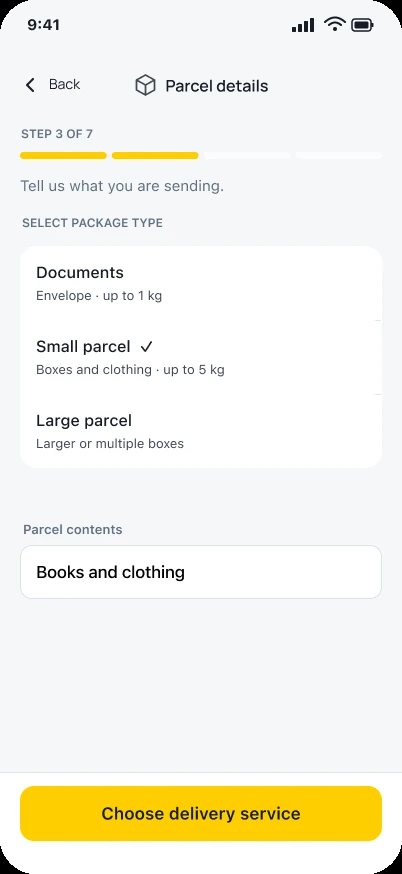
The Zapp parcel step is an example of a bounded review object. It can be inspected as part of a booking journey without pretending that a single screen explains dispatch, payment and delivery operations. A sensible scope makes those boundaries explicit.
Ask for a decision-ready deliverable
The output should contain reproducible findings, consequences, confidence, a proposed repair order and a verification plan. It should distinguish copy fixes, interaction changes, structural redesign and engineering defects.
Avoid a scope that promises a predetermined redesign regardless of what the evidence shows. An audit should be able to conclude that a smaller repair is enough, that more evidence is needed or that a part of the existing product deserves protection.
Do not delay urgent repairs for the perfect study
A clear access failure, data loss or broken critical path deserves attention while broader investigation continues. Record the original condition and test the repair. There is no need to wait for every secondary finding before addressing a verified problem.
For less certain concerns, make the next experiment small and reversible. The goal is a better product decision with a known basis, not a larger design programme justified by the existence of an audit.
Keep the first review small
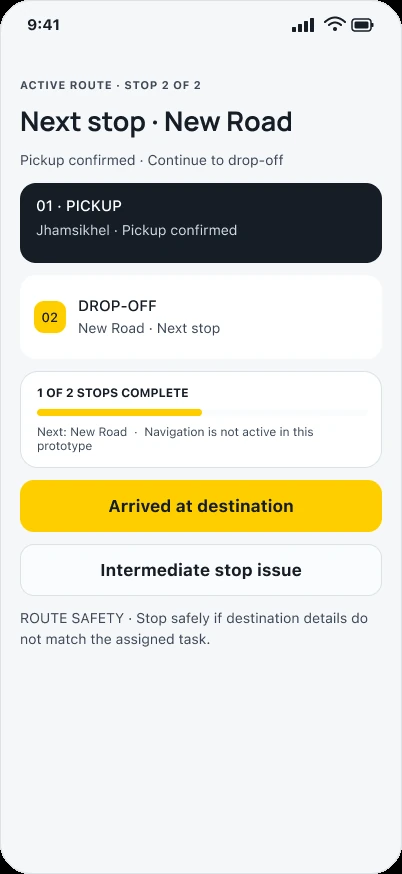
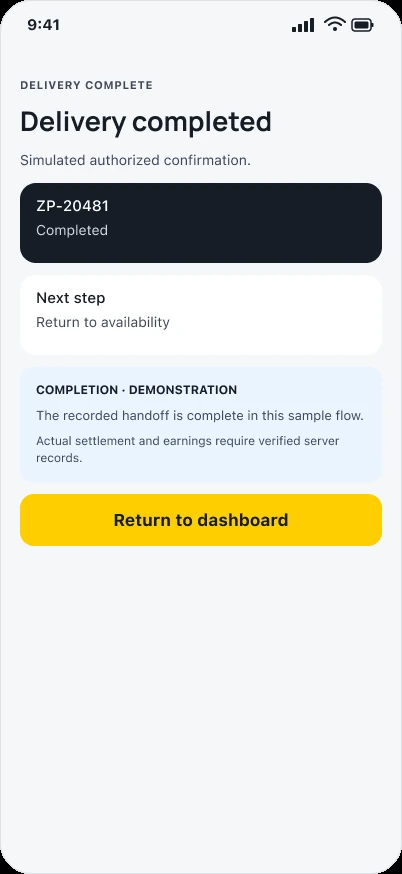
The Zapp driver sequence gives a useful boundary: identify the next stop, report an issue and reach completion. The completion design below gives the review an endpoint.
That is a manageable audit question. A complete delivery platform would also involve routing, dispatch and payment services, which need separate evidence.